Core buying criteria
Start with the failure points, not the catalog size.
Many heated stripping tanks look similar in a small product photo. The practical differences show up after months of heat, caustic residue, solvent vapor, and repeated cleaning. Buyers should look closely at wall gauge, enclosure rating, heater wiring, temperature redundancy, ventilation, drain design, and how easily an operator can understand a fault condition.
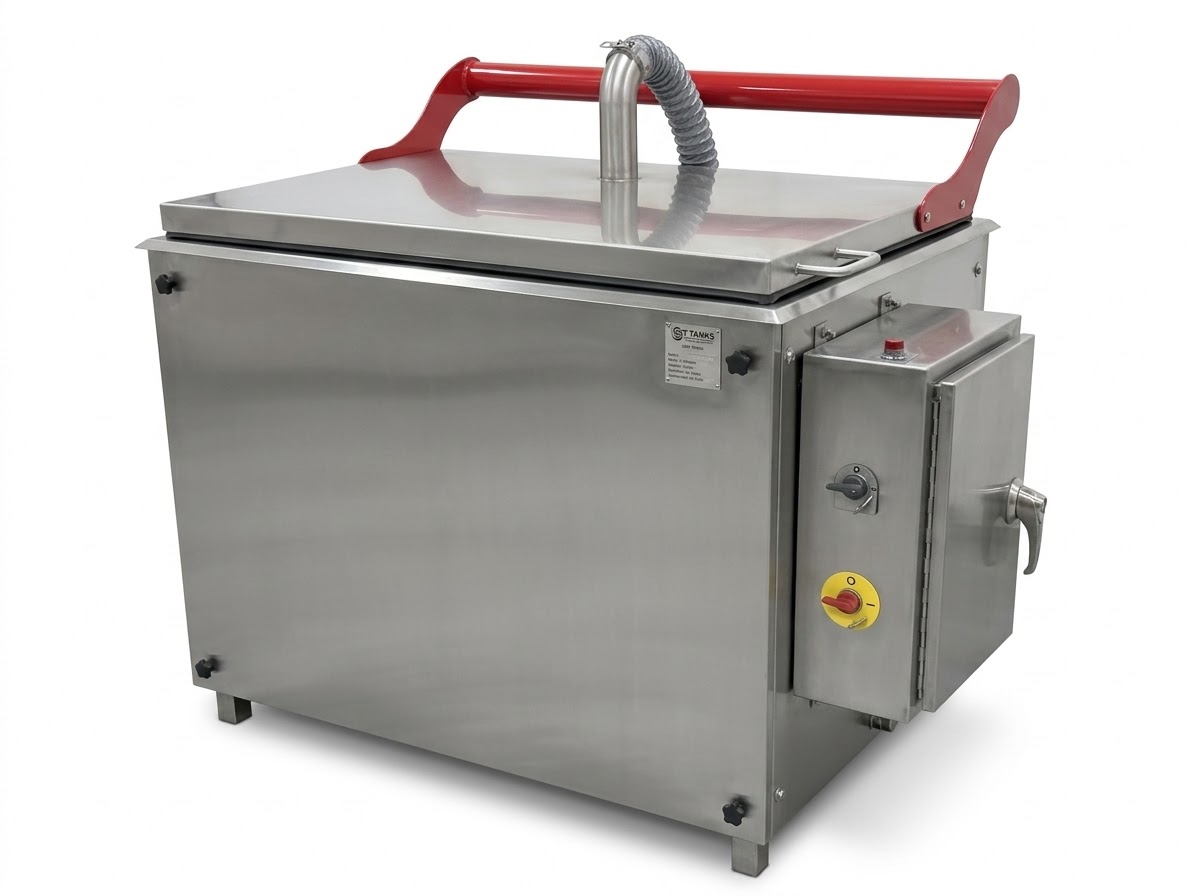
The WL4 uses 7-gauge 304 stainless steel, NEMA 4X stainless control enclosures, liquid-tight fittings, redundant temperature probes, a controller-independent snap disc cutoff, and a dual-drain sludge service layout. Those choices are intended to reduce downtime and reduce the amount of hot chemical handling needed during maintenance.
- 304 stainless tank body with 316 stainless wetted fittings
- Two 1000W strip heaters for controlled shop-scale heat-up
- 180F normal operating target with 200F maximum solution temperature
- 3-inch center lid vent for vapor and steam control
Safety
A good heated tank needs independent protection layers.
Heated chemistry should not depend on a single controller output. A stuck relay, failed sensor, or wiring fault needs to be visible before it becomes a runaway heat event. That is why the WL4 combines controller logic with hardwired electrical protection and simple LED diagnostics.
The mechanical snap disc is mounted outside the controller logic and can interrupt heater power independently. The SSR failure circuit watches for heater current when heat is not being called. The operator sees clear green, yellow, red, off, and flashing-red states instead of guessing whether the tank is heating normally.
Maintenance
Sludge service should not be a half-day exposure job.
Paint, powder, primer, and e-coat residue settle out as sludge. If the tank is hard to drain, shops often delay cleaning, which makes heat transfer worse and maintenance more hazardous. Separate liquid and sludge drains let operators remove solution and settled solids more deliberately.
The WL4 includes a 1-inch side drain and a 2-inch bottom sludge drain, each set in a 7-gauge reinforcement pad at the tank wall. The design is meant for real stripping shops where maintenance has to be repeatable, not improvised.
Questions buyers ask
Heated strip tank FAQ
What is a heated strip tank used for?
A heated strip tank is used to immerse coated parts in heated stripping chemistry so powder coating, paint, primer, e-coat, Cerakote, and similar finishes can release from the substrate.
What temperature does the WL4 heated strip tank run?
The WL4 is designed around a 180F operating target with a 200F maximum solution temperature and independent overtemperature protection.
Why does enclosure rating matter on a heated strip tank?
Heated stripping chemistry can create corrosive vapor and condensate. A NEMA 4X stainless enclosure helps protect controls from that environment better than a basic indoor enclosure.