Tank construction
Stainless thickness and fittings affect service life.
A chemical stripping tank should be built around the chemistry and the service routine. Thin material, unprotected fittings, and basic electrical enclosures can create expensive downtime when the tank is exposed to heated caustics, solvent-based strippers, sludge, and washdown.
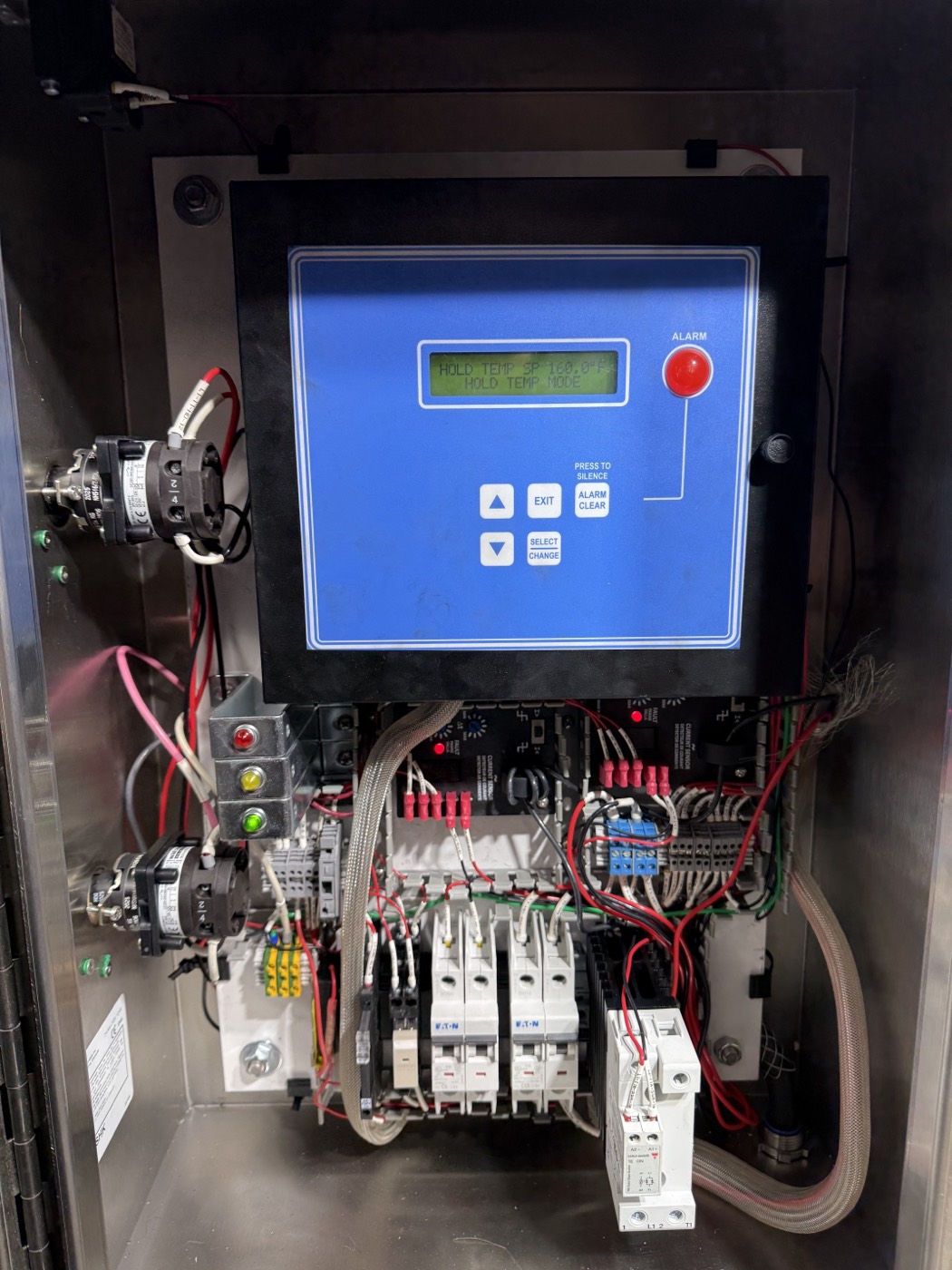
The WL4 uses 7-gauge 304 stainless construction with 316 stainless wetted fittings and NEMA 4X stainless control enclosures. Each tank also receives ForgeGuard passivation, a full-volume heated citric acid treatment intended to strengthen the stainless surface before field use.
- 7-gauge 304 stainless tank wall
- 316 stainless wetted fittings
- ForgeGuard full-volume passivation
- NEMA 4X stainless enclosures and liquid-tight fittings
Workflow
The best tank is the one operators can service correctly.
Stripping tanks accumulate residue. A tank that is difficult to drain or clean will either get neglected or force operators into poor workarounds. The WL4 separates normal liquid draining at the 1-inch side drain from sludge removal at the 2-inch bottom drain, and reinforces both user-handled fittings with 7-gauge pads at the tank wall.
For shops with special part sizes, higher throughput, unusual chemistry, or limited floor space, US Strip Tank Company can quote custom dimensions and workflow-specific changes.
Controls
Industrial stripping tanks need control visibility.
Useful controls do more than display a temperature. They help operators identify whether the tank is heating normally, whether one heater has failed, whether no current is present, or whether current is present when it should not be.
That is why the WL4 combines setpoint temperature control with independent current-state diagnostics and a mechanical high-temperature cutoff outside the controller.
Questions buyers ask
Heated strip tank FAQ
What materials are used in the WL4 chemical stripping tank?
The WL4 uses 7-gauge 304 stainless steel for the tank body and 316 stainless steel for wetted fittings.
Can chemical stripping tanks be custom sized?
Yes. Custom sizing can be quoted around part dimensions, basket size, chemistry, ventilation, throughput, and available floor space.
Why does passivation matter on a stainless stripping tank?
Passivation helps remove free iron from stainless steel surfaces and promotes the protective chromium oxide layer that helps stainless resist corrosion.